H.E. Mme. Ambassador Jiang Xiaoyan Published Article Titled "Safeguarding Ethnic Minority Languages: Nourishing Humanity's Shared Future"
In an article published by MKD on 5 November, H.E. Ambassador Jiang Xiaoyan shared her views on safeguarding ethnic minority languages. The full text is as follows:
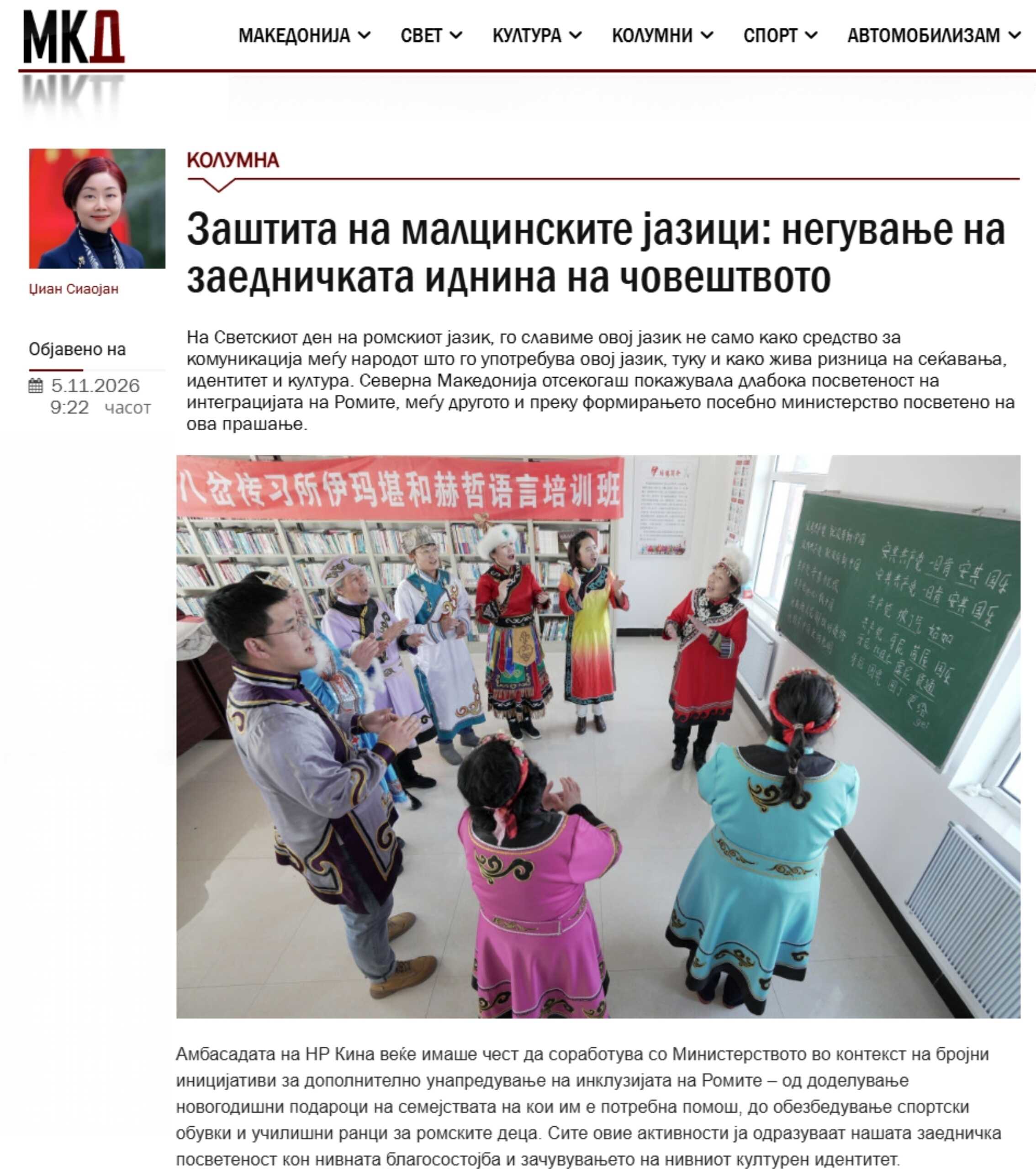
On the World Day of the Romani Language, we celebrate the Romani language not merely as a means of communication, but as a living vessel of memory, identity, and culture. North Macedonia has long demonstrated a profound commitment to Roma integration, notably through the establishment of a dedicated ministry. The Chinese Embassy has had the honor of partnering with the Ministry on numerous initiatives promoting Roma inclusion, from delivering New Year gift packages to families in need to providing sports shoes and schoolbags to Roma children—efforts that reflect our shared dedication to their well-being and cultural vitality.
Reflecting on North Macedonia’s multilingual reality invites a natural comparison with China’s own approach to linguistic diversity. As a unified multi-ethnic country, China’s 56 ethnic groups are bound together as one vibrant community of the Chinese nation. As President Xi Jinping has profoundly stated, “Culture is the soul of a nation, and cultural identity is the root of ethnic unity.” Guided by the vision that different ethnic cultures should respect, appreciate, and draw inspiration from one another, China attaches paramount importance to the protection and development of minority languages. Sharing China's experiences in this realm offers an opportunity to find points of contact with the Macedonian experience, recognize our shared challenges, and highlight a common conviction: that every language deserves the opportunity to thrive.
In China, the protection of minority languages begins with robust legal safeguards and comprehensive documentation. The Constitution guarantees all ethnic groups the freedom to use and develop their own spoken and written languages. Furthermore, the recently enacted Law on Promoting Ethnic Unity and Progress mandates the state to respect and protect the learning and use of minority languages, while supporting the preservation and research of ancient texts. Since 2015, China's Project for the Protection of Language Resources has systematically surveyed and recorded minority languages and dialects. This initiative has built the world's largest repository of its kind, digitally preserving a vast array of language varieties, including those that are endangered.
Beyond legal frameworks, mutually beneficial bilingual education serves as the lifeblood of linguistic transmission. In ethnic minority regions, schools teach both standard Chinese and the local minority language, equipping students with the tools for modern national life while keeping their native cultures vibrantly alive. From the Xizang plateau, where Tibetan-Chinese bilingual compulsory education is supported by over 30,000 teachers and the publication of more than 46 million Tibetan-language books, to the northern grasslands, where ethnic schools enroll nearly 500,000 students, the commitment is tangible. In Guangxi, 269 schools offer Zhuang-Chinese courses to more than 140,000 students, while in the mountains of Guizhou, Miao-language instruction is seamlessly integrated with the preservation of intangible cultural heritage and folk singing.
Crucially, a language survives only through its broader application and living transmission in daily life. In China's ethnic autonomous areas, minority languages are widely used in public spaces, government services, publishing, broadcasting, and judicial proceedings. Scripts for Mongolian, Tibetan, Uygur, Kazak, and Korean languages are fully encoded to international standards and supported across smartphones and the internet. Under the Intangible Cultural Heritage Law, oral literature and rituals are protected through a comprehensive four-tier safeguarding system. Innovative initiatives, such as study centers sustaining the Hezhen Yimakan storytelling tradition in Heilongjiang, or an AI resource bank for the endangered Hani language that transforms "language on the page" into an interactive experience, prove that ancient tongues can thrive in the digital age.
This holistic approach mirrors the commendable dedication in North Macedonia to nurturing a rich, multilingual society and protecting the linguistic and cultural rights of all its communities. It is truly inspiring to see schools offering electives in Albanian, Turkish, Serbian, Bosnian, and Romani language and culture. We also note with great appreciation the public support for mother-tongue textbooks and media, alongside the historic compilation of the country's first Romani grammar—a vital step in standardizing and passing on this beautiful language to future generations.
Every civilization embodies unique human wisdom; every language gives voice to a people's spirit. As both China and North Macedonia pursue modernization and shared development, we encounter parallel challenges—from addressing teacher and teaching-material shortages to reversing the weakening of intergenerational language transmission.
Navigating these hurdles requires more than just policy; it demands a commitment to the Global Civilization Initiative, where diverse linguistic heritages are viewed not as obstacles to unity, but as the very fabric of our shared human experience. By exchanging best practices in safeguarding minority languages, our two nations can ensure that languages and civilizations in all their beautiful diversity flourish side by side, providing enduring spiritual nourishment for the sustainable development of humanity.